The Great American Road Trip Used to Include Getting Completely, Hopelessly Lost — And That Was Half the Fun
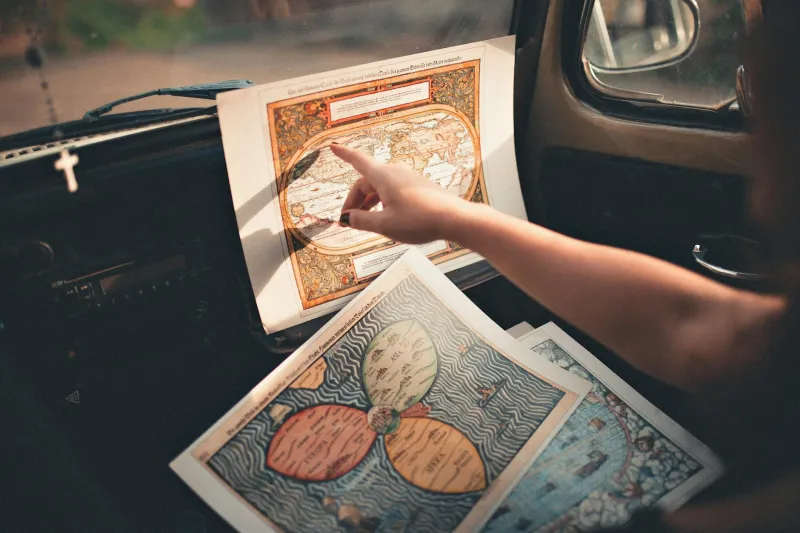
When Wrong Turns Led to Right Discoveries
Picture this: It's 1987, and you're driving from Chicago to Denver with nothing but a road atlas, a tank of gas, and the vague directions your cousin scribbled on a napkin. Somewhere outside Omaha, you realize you haven't seen a highway marker in an hour. Your passenger is holding the map upside down, arguing about whether that's north or south. And instead of panic, there's something almost... exciting about it.
This was the reality of American road travel for most of the 20th century. Getting lost wasn't a technological failure or a source of stress — it was simply part of the deal. You budgeted extra time for wrong turns the same way you budgeted for gas and snacks.
The Art of Navigation by Instinct
Before smartphones put a personal navigation system in every pocket, Americans developed an entirely different relationship with finding their way. The glove compartment of every car contained a well-worn road atlas, its pages soft from handling and marked with highlighter routes from previous adventures. These weren't just maps — they were historical documents of family trips, business journeys, and weekend getaways.
Gas station attendants were unofficial travel consultants. Pull up to a Texaco in rural Kansas, and the guy pumping your gas could give you detailed directions to anywhere within a 200-mile radius. "Take Highway 36 west about forty miles, turn right at the grain elevator — you can't miss it — then follow that road until you see the red barn." These directions, passed down through local knowledge and repeated thousands of times, were often more reliable than anything you'd find in a guidebook.
Families developed their own navigation traditions. Dad was usually the designated map reader, spreading the atlas across the steering wheel at rest stops while Mom kept mental notes about landmarks. Kids in the backseat became surprisingly good at spotting highway signs and calculating distances. Everyone had a role in the collective effort of getting from Point A to Point B.
The Culture of Acceptable Uncertainty
What's remarkable about pre-GPS travel culture was how comfortable Americans were with uncertainty. Getting lost for an hour or two wasn't a crisis — it was Tuesday. Families would pack extra snacks and plan for "scenic detours" that were really just polite ways of acknowledging they'd probably take a few wrong turns.
This acceptance created space for serendipity that's largely disappeared from modern travel. The wrong exit that led to a charming small town with the best pie in three states. The missed turn that revealed a stunning overlook not mentioned in any guidebook. The detour through farmland that became the most memorable part of the entire trip.
Local diners and roadside attractions thrived partly because lost travelers needed places to regroup, grab coffee, and ask for directions. "How do I get back to I-80?" was probably the most common question heard in small-town restaurants across America. These establishments understood their role as waypoints for confused travelers and often had hand-drawn maps ready to share.
The Great Transformation
The shift didn't happen overnight. MapQuest bridged the gap in the late 1990s, letting people print turn-by-turn directions from their home computers. Suddenly, you could have professional-grade directions without relying on gas station wisdom or your own map-reading skills. But you still had to plan ahead, and once you were on the road, you were committed to whatever route you'd printed.
Then came GPS devices, followed by smartphone navigation, and everything changed. Today's travelers can recalculate their route instantly, avoid traffic in real-time, and receive warnings about speed traps ahead. The idea of being genuinely lost — as in, having no idea where you are or how to get where you're going — has become almost obsolete.
What We Gained and What We Lost
Modern navigation is undeniably superior in terms of efficiency, safety, and stress reduction. Emergency services can locate stranded motorists instantly. Business travelers can navigate unfamiliar cities with confidence. Road trips that once required days of planning can be undertaken spontaneously.
But something subtle disappeared when we engineered uncertainty out of travel. The patience required to unfold a map and study it carefully. The satisfaction of successfully navigating by dead reckoning and landmark recognition. The stories that came from unexpected detours and wrong-turn discoveries.
Perhaps most importantly, we lost the shared experience of being lost together. Modern travelers sit in silent cars, following robotic voice commands and trusting algorithms to make every navigation decision. The collaborative problem-solving that once defined American road trips — the debates over routes, the collective search for landmarks, the celebration when you finally figured out where you were — has largely vanished.
The Adventure of Not Knowing
Today, a dead phone battery in an unfamiliar place can cause genuine anxiety. We've become so dependent on turn-by-turn guidance that the idea of navigating by intuition feels impossible. But for most of American history, intuition was all travelers had — and somehow, they managed just fine.
Getting lost used to be an adventure, not a failure. It was how you discovered that the best barbecue in Missouri was in a town you'd never heard of, accessible only by taking the wrong exit and following your nose. It was how you learned that sometimes the scenic route really was worth the extra time, even when you didn't choose it deliberately.
In our rush to optimize every journey, we may have lost something valuable: the understanding that not all worthwhile destinations can be programmed into a GPS. Sometimes the best parts of the trip are the ones you never planned to take.