The Weight of Knowledge
In 1975, the Britannica Encyclopedia salesman knocked on doors across suburban America with a pitch that would sound absurd today: spend $1,200 — roughly three weeks of median household income — on 24 volumes of information that would sit on your shelf for decades. And millions of families said yes.
These weren't just books. They were investments in their children's education, physical manifestations of knowledge that demanded respect through sheer mass. Each volume weighed several pounds. Moving the complete set required planning. And when your fourth-grader needed to research the Civil War, they couldn't just type a question into a search bar.
The Ritual of Research
Homework in pre-internet America was an endurance test. A single assignment on ancient Egypt might require:
- A trip to the public library after school
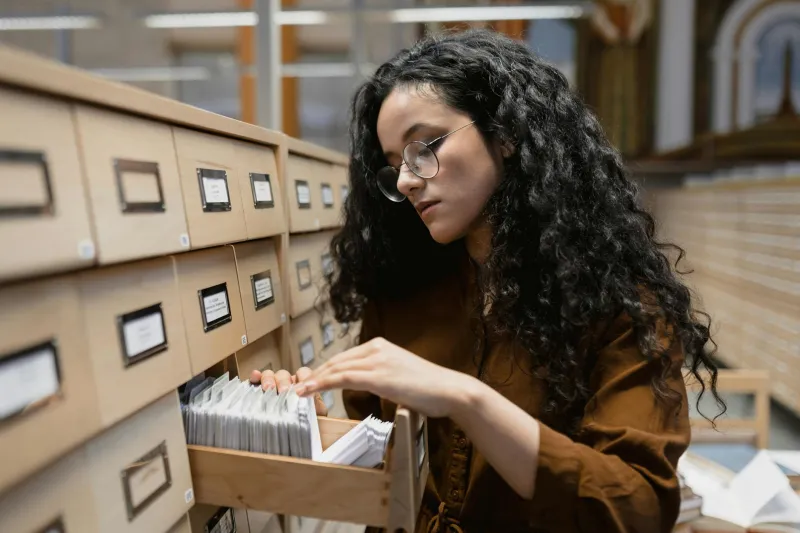
- Consultation with the card catalog (a skill taught in elementary school)
- Physical retrieval of multiple books from different floors
- Handwritten notes on index cards
- Careful citation of page numbers and publication dates
- Hours of reading, cross-referencing, and synthesis
The process could take an entire weekend. Students developed what we'd now call "information architecture" skills by necessity — they had to understand how knowledge was organized, cataloged, and connected. They learned to evaluate sources because finding bad information was almost as time-consuming as finding good information.
Most importantly, they couldn't multitask. Research required sustained attention, deep focus, and the ability to hold complex ideas in working memory while building an argument piece by piece.
The Librarian as Navigator
School librarians weren't just book-keepers; they were knowledge navigators. They knew which resources contained what information, could guide students through research strategies, and taught essential skills like using the Reader's Guide to Periodical Literature — a massive index that helped students find magazine articles on their topics.
These professionals understood that learning wasn't just about finding answers, but about developing the cognitive muscles required to wrestle with difficult questions. They watched students struggle with sources, synthesize conflicting information, and build original arguments from primary materials.
The Transformation
Today's students live in an information paradise that would have seemed magical to their 1970s counterparts. Need to know about ancient Egypt? Wikipedia provides more information than those old encyclopedias, updated in real-time, with multimedia content and links to primary sources. AI tutors can explain complex concepts in multiple ways until they click. Online databases provide access to academic papers that were once locked away in university libraries.
The average high school student today has access to more information in their pocket than existed in most public libraries 50 years ago. Research that once took days now takes minutes. Citation formatting happens automatically. Language barriers dissolve with instant translation.
What We Gained and Lost
The gains are obvious: democratized access to information, reduced barriers to learning, and the ability to explore topics with unprecedented depth and breadth. A curious teenager can now dive into quantum physics, medieval history, or molecular biology with resources that would have required a PhD and university access in 1975.
But something subtler was lost in the transition. The physical effort of research — walking to libraries, hunting through card catalogs, carrying heavy books — created what psychologists call "desirable difficulty." The struggle to find information made it more memorable and valuable.
Modern students often struggle with what researchers call "cognitive load." With infinite information available instantly, the challenge isn't finding answers but determining which answers are worth finding. The abundance that should enhance learning often overwhelms it.
The Attention Economy
Perhaps most significantly, the old system trained sustained attention as a byproduct. Students had no choice but to focus for extended periods. They couldn't check social media, bounce between browser tabs, or get distracted by notifications. The limitations of physical research created natural boundaries that protected deep thinking.
Today's students report feeling scattered, anxious, and unable to concentrate for long periods. They have access to better information but often lack the mental stamina to fully process it. Teachers increasingly report that students can find facts quickly but struggle to synthesize them into coherent arguments.
The Deeper Question
The transformation of homework and research reflects a broader shift in how Americans relate to knowledge itself. We've moved from a scarcity model — where information was precious and required effort to obtain — to an abundance model where the challenge is filtering and focus.
Our grandparents' generation learned to value information because it was hard to get. Today's students must learn to value attention because it's hard to maintain. Both challenges are real, but they require completely different skills.
The question isn't whether we should return to encyclopedia sets and card catalogs — that ship has sailed. Instead, we might ask: How do we preserve the cognitive benefits of "desirable difficulty" in an age of infinite information? The answer may determine not just how the next generation learns, but how well they think.