Film Was Expensive. That's Why Your Grandparents' Photos Actually Meant Something.
When Every Photograph Had a Cost
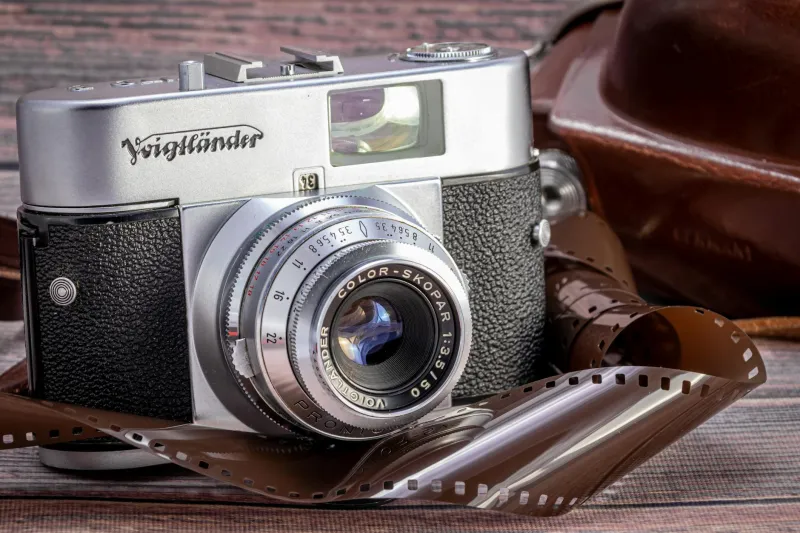
Let's say it's 1975. You're at your daughter's birthday party. You have a camera—not a fancy one, just a standard 35mm film camera. You load in a roll of Kodak film. It has 24 exposures.
Twenty-four. That's it. That's your budget for the entire party.
You think carefully about what to photograph. The moment she blows out the candles? Yes. A picture of her with her friends? Maybe, but you have to make it count. A candid shot of her laughing? You'd love to, but you only have 24 frames, and there are other moments coming up. You might not get another chance.
You shoot the party. You use maybe 15 exposures. You put the camera away.
Then you wait. You take the film to the drugstore. The photographer there puts it in an envelope and tells you it'll be ready in three to five days. Sometimes it took a week.
When you finally got the photos back, you'd open the envelope and see what you'd actually captured. Some shots were blurry. Some were poorly framed. Maybe three or four were genuinely good.
You'd put those good ones in an album. The rest went in a drawer, and most people eventually threw them away.
That was it. That was how photography worked for about a hundred years.
The Economics of Scarcity
Here's what's important about that system: it made photographs precious.
A roll of film cost money—not a lot, but enough that you thought about it. Development cost money too. So every photograph was an investment. You didn't take 87 photos hoping one would turn out; you took maybe 20, and you aimed to make each one count.
This created a kind of intentionality. You thought about composition. You thought about the moment. You thought about whether this was worth one of your 24 exposures.
And because photographs were limited, people actually looked at them. They put them in albums. They showed them to friends. They organized them. They remembered where each photo was taken and what was happening in the moment.
Photographs were a record of your life, and you treated them that way.
Parents in the 1970s and 1980s have photo albums that tell a coherent story of their children's childhoods. You can flip through and see growth, change, seasons passing. The photos are curated—not in a fake way, but in the sense that the bad ones were discarded and the good ones were kept.
They're memorable.
The Shift
Digital cameras arrived in the late 1990s and early 2000s. At first, they were clunky and low-quality. But they had one revolutionary feature: storage was nearly unlimited, and it was essentially free.
You could take a hundred photos. A thousand. It didn't matter. The marginal cost of each additional photo was zero.
This changed everything about how people photograph.
Instead of thinking about each shot, you could just shoot continuously. Instead of being selective, you could be comprehensive. Instead of 24 exposures, you could have 2,400.
Smartphones accelerated this. Now everyone has a camera with them at all times. Taking a photo costs nothing. Storing it costs nothing (thanks to cloud storage). Sharing it costs nothing.
We've moved from scarcity to absolute abundance.
The Age of Infinite Photos
Let's flash forward to 2024. You're at your daughter's birthday party, and you have a smartphone.
You take 87 photos.
Not 24. Not even 50. Eighty-seven. You take photos of the cake. Multiple angles. You take photos of her with each friend. You take selfies. You take video. You take photos of people taking photos.
Then you scroll through them. You realize 86 of them are basically the same. You delete most of them. You keep maybe one good one and post it to Instagram.
The rest? They're stored in your cloud somewhere. You'll never look at them again.
This is the new normal. We take vastly more photos than we ever did in the film era. We keep almost none of them. We look at almost none of them.
A parent with a smartphone probably has 10,000 photos of their kids on their phone. A parent with film cameras probably had maybe 500 for the entire childhood, and they'd actually seen and organized all of them.
Who has more memories? Who actually remembers their child's childhood better?
The Paradox of Abundance
There's something counterintuitive happening here.
We're capturing more moments than ever before. We're documenting our lives in unprecedented detail. And yet, we're remembering less.
Psychologists call this the "Google effect"—the tendency to forget information that's easily accessible. If you know you can look something up, you're less likely to remember it.
It applies to photos too. If you know you have 87 photos from the birthday party stored in the cloud, you don't need to remember which moments were important. You don't need to organize them or think about them. They're just... there.
Meanwhile, your grandmother's photo album—with maybe 30 photos from her daughter's childhood—is something she can actually hold in her hands. She can flip through it and remember the story. She's looked at those photos a hundred times. She knows them.
Your photos? You've probably never looked at 99% of them.
The Loss of Curation
There's another thing that's changed: the human curation process.
When you had 24 exposures, the photographer had to choose which moments to capture. Then, when the photos came back, you had to choose which ones were worth keeping. This created a natural filtering process. The best moments, the best shots, the ones that actually meant something—those were the ones that survived.
It was a form of meaning-making. By choosing what to keep, you were deciding what mattered.
Now, algorithms do the curation. Google Photos uses AI to identify "important" moments and surface them. Your phone automatically creates highlight reels. Instagram's algorithm decides which photos get seen.
But these aren't your choices. They're the algorithm's choices. And the algorithm doesn't know what actually matters to you. It knows what gets engagement. It knows what's technically well-composed. It doesn't know that a blurry photo of your kid laughing is more important to you than a perfectly lit professional portrait.
The Smartphone Effect
Here's what's really changed: taking a photo used to be an intentional act. You had to own a camera. You had to load film. You had to think about what you were doing.
Now, taking a photo is the default. You pull out your phone for any reason, and the camera is there. You might as well take a photo. It costs nothing.
This has made us more photographed and less intentional. We're documenting everything and remembering nothing. We're capturing moments without thinking about whether they're worth capturing.
And there's a weird psychological effect: the act of taking the photo has become a substitute for the experience itself. You're so focused on getting the shot that you're not actually present for the moment.
Film photographers—the ones who still use film—report that they're more present. Because they have limited exposures, they have to choose carefully. They have to be in the moment. They have to experience the thing before they photograph it.
Then, when they finally see the photos weeks later, they're seeing a curated collection of the moments that actually mattered. And those photos mean something.
The Now and Then
Then: You took 24 photos. You chose carefully. You waited days to see the results. You kept the good ones and discarded the rest. You looked at your photos regularly. They told a story.
Now: You take 87 photos. You scroll through them for 30 seconds. You post one to Instagram. The rest go into the cloud, never to be seen again. You have 10,000 photos and remember almost none of them.
We've gained the ability to capture everything. We've lost the ability to remember anything. We've traded a few precious photographs for an infinite archive of forgettable ones.
The question isn't whether digital photography is better than film. It obviously is in many ways—it's more convenient, more accessible, more democratic.
The question is whether we've lost something important in the shift from scarcity to abundance. Whether the meaningfulness of a photograph—the way it forces you to choose, to remember, to care—is inseparable from its cost.
Your grandmother's 30-photo album might tell the story of her daughter's childhood better than your 10,000-photo digital archive tells the story of yours. And that's worth thinking about.