The Last Time Americans Truly Rested
In 1975, when Jim Morrison from accounting called in sick, he vanished. No forwarded emails, no "just checking in" calls, no laptop balanced on his nightstand while he sipped chicken soup. He was sick, so he was gone — and everyone understood that meant gone.
The concept was beautifully simple: illness meant disconnection. Your body was broken, so you fixed it. Work would wait because work had to wait. There wasn't any other option.
Fast-forward to today, and we've created something that would have baffled previous generations: the half-sick workday. We're too unwell to go to the office but too guilty to truly step away. So we compromise, creating this bizarre middle ground where we're neither fully present at work nor properly focused on recovery.
When Sick Days Had Actual Boundaries
The pre-digital workplace operated on clear divisions. You were either at work or you weren't. If you weren't, people assumed you had a good reason — and they left you alone.
This wasn't just about technology limitations. It reflected a fundamentally different relationship with work and personal boundaries. Employers expected that sick employees would be unreachable, and employees felt no pressure to prove their dedication from their sickbed.
Consider the mechanics of 1980s sick leave: You called your supervisor (on a landline), explained you were ill, and that was it. No photos of thermometers, no detailed symptom reports, no promises to "monitor email periodically." The conversation lasted thirty seconds because there was nothing else to discuss.
The Laptop That Ruined Recovery
The shift began innocuously enough. First came cell phones, making us reachable anywhere. Then laptops made work portable. Finally, smartphones put the entire office in our pocket.
Each innovation was sold as convenience — work when you want, where you want. But convenience has a way of becoming expectation. Being able to check email from bed gradually morphed into being expected to check email from bed.
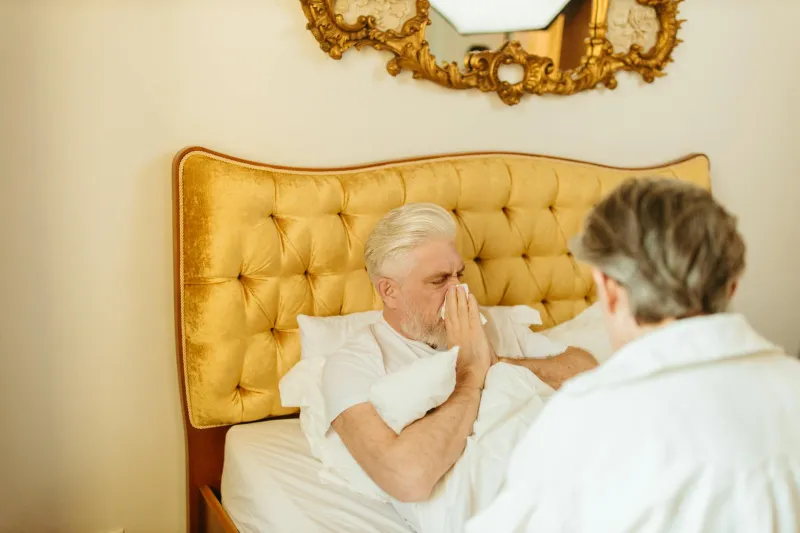
Today's sick day often looks like this: You wake up feeling terrible, text your manager that you're "under the weather" but will "keep an eye on urgent matters," then spend the day in a feverish haze of half-completed tasks and guilt-ridden rest periods.
We've created a cultural norm where being too sick to commute somehow doesn't mean being too sick to work. It's a logical inconsistency that would have mystified previous generations.
The Guilt Economy of Modern Illness
Somewhere along the way, we started treating illness like a personal failing rather than a biological reality. The language shifted from "I'm sick" to "I'm not feeling well" — as if we needed to soften the blow of our own humanity.
This guilt manifests in peculiar ways. We over-explain our symptoms to justify our absence. We promise to "make up the time" when we return. We check email obsessively to prove we're not really slacking off.
Your grandfather's generation would have found this behavior baffling. They understood that bodies break down occasionally, just like machines. When your car wouldn't start, you didn't feel guilty about taking the bus. When your body wouldn't function, you didn't feel guilty about staying home.
The Always-On Trap
The modern workplace's greatest trick was convincing us that being always available was a privilege rather than a burden. We bought into the narrative that flexibility meant freedom, when it actually meant the dissolution of protective boundaries.
Remote work capabilities were supposed to give us more control over our time. Instead, they've made every space a potential workspace and every moment a potential work moment. Your bedroom isn't a sanctuary when your laptop lives there.
This constant connectivity has fundamentally changed what it means to be "sick." Previous generations had natural recovery periods built into their world. Today, we have to actively create those boundaries — and most of us aren't very good at it.
The Health Cost of Half-Measures
Medical professionals will tell you that partial rest often extends illness rather than shortening it. When you're answering emails between naps, your body can't fully commit to healing. You're stuck in this liminal space between sickness and health, work and rest.
Our grandparents' approach — complete disconnection during illness — wasn't just culturally different. It was medically superior. They recovered faster because they actually rested.
What We Lost in Translation
The shift from "sick days" to "work-from-home-while-sick days" represents more than technological change. It reflects a fundamental transformation in how we view the relationship between our bodies, our work, and our worth.
Previous generations understood that humans weren't machines. They expected periodic breakdowns and planned accordingly. Modern workplace culture, despite its surface-level concern for "wellness," has actually made us less willing to acknowledge our physical limitations.
We've traded the simple wisdom of our grandparents — when you're sick, you rest — for a complex system of partial presence and constant guilt. It's hard to argue we've made progress.
The Way Back to Real Rest
Reclaiming the lost art of being truly sick requires intentional boundary-setting in a world designed to eliminate boundaries. It means turning off the laptop, ignoring the phone, and remembering that your value as a person isn't measured by your response time to emails.
Your grandfather knew something we've forgotten: sometimes the most productive thing you can do is absolutely nothing at all.