Busy Signals, Party Lines, and the Neighbor Who Kept Tying Up the Phone: When Reaching Someone Was Never Guaranteed
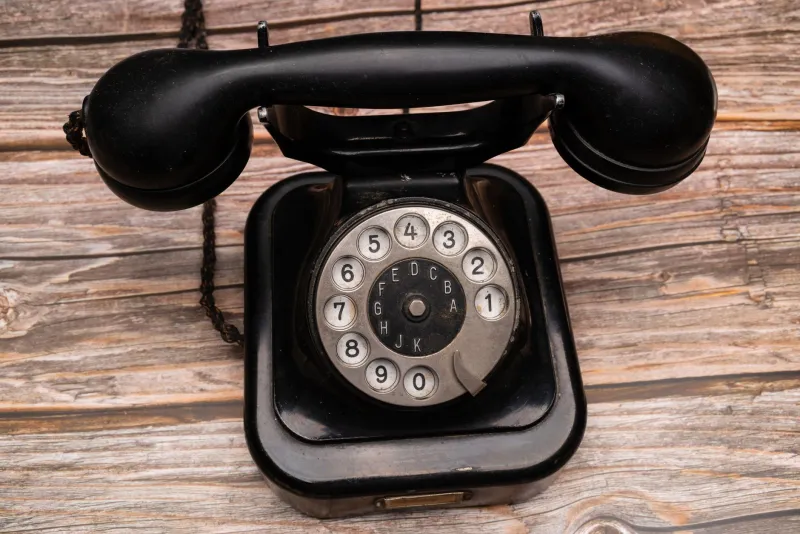
Picture this: it's 1954. You need to call your sister in the next town. You pick up the receiver, and instead of a dial tone, you hear two women mid-conversation — neither of them you, neither of them your sister. You wait. You check back in ten minutes. Still talking. You try again after dinner. Finally, at 8:45 PM, the line is clear. You dial. It rings. And rings. And rings. No answer.
You try again tomorrow.
That experience — utterly ordinary for tens of millions of Americans through the mid-20th century — is so foreign to modern life that it almost sounds like fiction. But it wasn't. It was just Tuesday.
What a Party Line Actually Was
For most Americans today, the phrase "party line" conjures up vague, vaguely amusing images from old movies. The reality was far more mundane and considerably more frustrating.
In rural and small-town America especially, telephone companies didn't have the infrastructure to give every household its own dedicated line. Instead, multiple families shared a single circuit. When someone on your party line picked up their receiver, you could hear them. When you picked up yours, they could hear you. Privacy was a courtesy, not a guarantee.
Each household on the line had a distinctive ring pattern — two long rings and a short one might be yours; one long ring might be your neighbor's. You were supposed to only pick up for your pattern. In practice, plenty of people picked up for everyone's. Eavesdropping wasn't just possible; it was a known social phenomenon with its own etiquette norms and neighborhood tensions.
If the Hendersons down the road had a teenage daughter who spent two hours every evening on the line, the rest of the party — farmers needing to call the feed store, mothers trying to reach the doctor — simply had to wait. There was no workaround. You waited.
By the early 1950s, roughly a third of American telephone subscribers were on party lines. In some rural areas, lines had as many as eight households sharing them.
The Busy Signal: America's Most Infuriating Sound
Even once private lines became more common, getting through to someone was far from simple. The busy signal — that relentless, rhythmic beeping — was a fixture of American daily life in a way that's genuinely hard to convey to anyone who grew up with mobile phones.
There was no voicemail until the 1980s, and answering machines didn't become mainstream until around the same time. If someone was on their phone, or if the call didn't connect, there was no fallback. No message left, no notification sent, no record of the attempt. You just had to try again.
For families with teenagers, this was a particular domestic battleground. One phone in the house — usually mounted on the kitchen wall — served everyone. A 16-year-old who monopolized it for an hour after school wasn't just being inconsiderate; they were actively cutting off the household from the outside world. Parents enforced time limits with real urgency, not just mild irritation.
Businesses dealt with busy signals as a matter of operational reality. Calling a popular restaurant to make a reservation might require a dozen attempts spread across an afternoon. Calling a doctor's office first thing Monday morning was understood to be a test of patience and persistence. You hit redial — physically, by hanging up and dialing again — and you kept going.
Long Distance Was a Financial Decision
Beyond the logistics of getting through, there was the matter of cost. Long-distance calls — anything outside your local calling area — were priced by the minute, and the rates were significant. Calling a relative in another state for a leisurely catch-up chat wasn't something most working-class families did casually.
Calls were planned. Kept short. Sometimes scripted in advance so no time was wasted. "I'll call Sunday at 7, and we'll talk for ten minutes" was a real arrangement that real families made and kept. The three-minute long-distance call wasn't a cultural joke — it was a genuine economic constraint.
Operators were part of the equation too, particularly for long-distance and international calls. You didn't just dial a number; you sometimes went through a human being who connected the circuit manually. Calling internationally from a private home in 1960 was an elaborate production involving operator assistance, significant expense, and the real possibility that the call simply wouldn't connect at all.
The Assumptions We've Built Without Noticing
Somewhere between the party line era and today, Americans developed a set of expectations about communication that are so deeply embedded we've stopped recognizing them as expectations at all.
We assume that when we call someone, they'll either answer or we'll be able to leave a message. We assume that if something is urgent, we can reach almost anyone almost immediately. We assume that our calls are private. We assume that the cost of a call is effectively zero. We assume that distance is irrelevant.
Every single one of those assumptions would have been unrecognizable to an American household in 1950.
Today, a smartphone in your pocket gives you instant, private, essentially free voice access to anyone on earth — plus video, text, photos, and documents, all simultaneously. You can leave a voicemail, send a follow-up text, and get a read receipt confirming delivery, all within thirty seconds of a missed call.
The contrast isn't just technological. It's psychological. The mid-century experience of telephone communication built tolerance for uncertainty and failure into everyday social life. You might not reach someone. That was simply a known condition of existence. You planned around it, made contingency arrangements, and accepted that some connections would require multiple attempts across multiple days.
What We Lost in the Frictionlessness
There's a reasonable argument that instant, frictionless communication has made certain things worse alongside the many things it's made better. When reaching someone is always possible, being unreachable becomes a social statement. When messages can always be delivered, not responding becomes a choice that carries weight. The uncertainty that once made communication naturally forgiving has been replaced by a system where every gap in response is visible and interpretable.
The busy signal, frustrating as it was, carried no social meaning. It just meant the line was occupied. Nobody read anything into it.
The unread message is a different matter entirely.
Mid-century Americans built their social lives around the limitations of their communication tools. They made plans and kept them because there was no easy way to cancel at the last minute. They showed up because calling ahead to say you weren't coming was often harder than just going. The friction in the system created a kind of social reliability that instant communication, paradoxically, has made harder to sustain.
The party line is long gone. The busy signal is a sound most people under 30 have never heard. And the experience of genuinely not being able to reach someone — of accepting that uncertainty as a normal feature of daily life — has quietly disappeared along with them.