Before Facebook, the Class Reunion Was the Great American Mystery
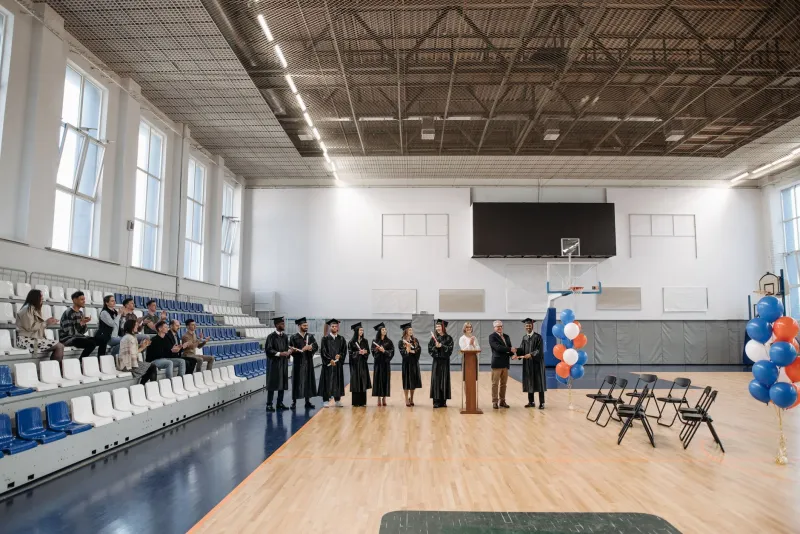
Somewhere in a gym decorated with balloon arches and a banner reading Class of '84 — 20 Years Later, a woman is scanning the room trying to figure out which of these people is Danny Kowalski. Danny sat behind her in homeroom for three years. He was skinny, loud, perpetually wearing a Def Leppard shirt, and she hasn't thought about him in roughly a decade. Then someone taps her on the shoulder and she turns around and it is Danny Kowalski — except he's now broad-shouldered, quiet, and apparently runs a landscaping business in Flagstaff.
That moment — that specific, slightly disorienting experience of confronting how much a person can change in ten years — was the whole point of the American class reunion. And it's essentially gone.
What the Reunion Actually Was
For most of the twentieth century, the high school class reunion operated on a simple but powerful premise: you lost track of people, and then, once every five or ten years, you found them again. There was no mechanism for staying updated. You might hear secondhand that someone had moved to Seattle, or gotten divorced, or done well for themselves in insurance — but these were rumors, incomplete and often wrong.
The reunion was the correction. The room where you found out what actually happened.
And because the information gap was so wide, the anticipation was real. You didn't just wonder who would show up. You genuinely had no idea what they would look like, what they'd become, or whether the person you remembered bore any resemblance to the person who walked through the door. People prepared for reunions with a specific kind of nervous energy that mixed curiosity, vanity, and something close to genuine excitement.
The reunion was, in its own way, a form of time travel. You walked into a room and the past and present collided without warning.
The Slow Reveal Was the Experience
There's a reason people talked about class reunions for weeks beforehand and weeks afterward. The experience had genuine narrative tension. Who got rich? Who got fat? Who was still with the person everyone assumed they'd leave? Who showed up looking like they hadn't aged a day, and who showed up looking like they'd aged twenty extra years?
Those questions sound shallow when you list them out, but they point to something deeper: the reunion forced you to reckon with the passage of time in a way that was impossible to avoid. You were confronted, all at once, with the distance between who people were at seventeen and who they'd become at twenty-seven or thirty-seven. That confrontation was uncomfortable and fascinating and, for many people, genuinely moving.
It also forced a kind of honest self-assessment. You couldn't control what people saw when they looked at you. There was no profile to curate, no flattering photo to select. You just showed up, and whatever the years had done to you was on display.
There was something clarifying about that.
Then Facebook Happened
The transformation wasn't sudden, but it was thorough. By the late 2000s, Facebook had quietly dismantled the entire information architecture on which the class reunion depended. The slow reveal — the decade-long gap between glimpses of other people's lives — was replaced by a continuous, voluntary broadcast.
You no longer had to wait ten years to find out that your high school boyfriend had moved to Portland, remarried, and taken up competitive cycling. You knew approximately six weeks after it happened because he posted about it. You'd watched his kids grow up in real time through holiday photos. You'd seen his opinions on things you'd rather not know his opinions on.
By the time the reunion arrived, there was nothing left to discover. The room that once held genuine mystery now held people you already knew too much about — or thought you did — and the specific electricity of the old-style reunion simply couldn't generate itself under those conditions.
Reunion attendance has declined steadily since the early 2000s. Organizers who once filled hotel ballrooms now struggle to get a third of the class to show up. The explanations people give vary — busy schedules, the cost of travel, general social fatigue — but the underlying shift is harder to articulate. The reunion lost its reason for being.
What Was Actually Lost
It's worth being precise about what disappeared, because it wasn't just a party format. The pre-social-media reunion enforced a kind of temporal honesty that our current information environment actively resists.
When you could only see someone once a decade, you couldn't pretend that time wasn't passing. The reunion made the passage of years undeniable and visible and shared. Everyone in that room was aging together, changing together, moving through the same river at different speeds. The reunion was the moment you all stopped and looked at each other and acknowledged it.
Social media, by contrast, allows everyone to manage their own narrative continuously. You share what you choose. You present the version of your life that reflects well on you. The aging happens, but it happens in carefully curated increments, softened by filters and selective posting. Nobody walks into a room and confronts you with all of it at once.
The reunion also created genuine reconnection — not the performative reconnection of a Facebook friend request, but the kind that happened when you sat next to someone for two hours and actually talked. People left reunions having genuinely rekindled friendships that mattered. Some of those friendships lasted. The algorithm doesn't produce the same result.
The Room Is Quieter Now
The class reunion still exists, technically. Committees still form, venues still get booked, name tags still get printed. But the people who attend will tell you that something is different — flatter, somehow, than they expected. The conversations happen against a backdrop of things already known, updates already received, surprises already spoiled.
What's gone is the anticipation that made the whole thing worth the plane ticket. The sense that you were walking into a room full of unresolved questions. The specific, irreplaceable experience of seeing ten years of change compressed into a single moment of recognition.
Danny Kowalski in Flagstaff with his landscaping business — you already knew about that. He posted about it last spring. The moment that would have stopped you cold in 1989 is just a confirmation of something you already scrolled past.
And that, quietly, is a genuine loss.