A Dollar Used to Mean Something Very Different: The Surprising Truth About What Things Actually Cost
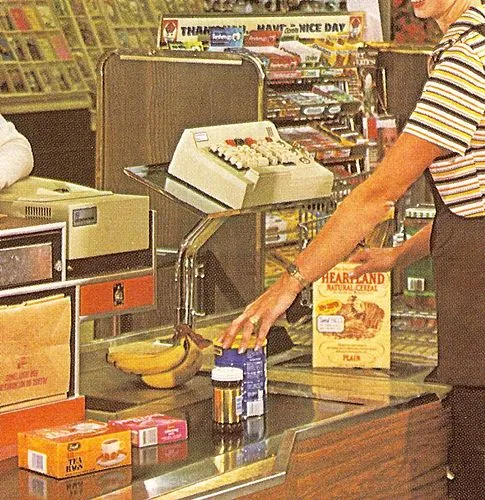
Photo: vintage 1980s grocery store prices supermarket checkout retro American, via i.pinimg.com
Pull out your wallet and think about the last thing you bought. Now imagine explaining the price to your parents in 1985. Depending on what it was, they'd either nod knowingly or stare at you like you'd grown a second head.
Inflation is one of those economic forces that everyone understands in the abstract and almost nobody feels accurately in real time. We know things cost more than they used to. What we tend to miss is how much more—and more importantly, why some things have exploded in cost while others have barely budged. The gap between those two categories is where the real story lives.
Let's Start With a Stamp
In 1980, mailing a first-class letter cost 15 cents. By 2000, that had risen to 33 cents. Today, as of 2024, you're paying 68 cents. That's a significant jump, no question—but if you adjust for general inflation, a 1980 stamp should cost roughly 57 cents in today's dollars. The actual price is higher than inflation would predict, but not wildly so. The postal service, for all its problems, hasn't exactly been the villain of the affordability crisis.
Now let's talk about college.
In 1980, the average annual cost of attending a four-year public university—tuition, fees, room and board—was around $3,500. Adjusted for inflation, that's approximately $13,000 in 2024 dollars. The actual average today? Closer to $28,000 per year at public institutions, and well over $60,000 at many private universities. That's not inflation. That's a structural transformation of an entire sector of American life, and it happened quietly enough that each generation absorbed the shock without fully registering how dramatic the change had become.
Gas, Groceries, and the Things That Feel Stable
Gasoline is the price Americans track most emotionally, partly because it's displayed in giant numbers on signs you pass every day. In 1980, the national average for a gallon of regular gas was about $1.19—which sounds impossibly cheap until you realize that adjusted for inflation, it's roughly equivalent to $4.50 today. The current national average in mid-2024 hovers around $3.40 to $3.60 depending on the region.
Wait. Gasoline is actually cheaper in real terms than it was in 1980? For most of the past two decades, yes—though that figure swings dramatically with global oil markets and geopolitical events. The 2022 spike to over $5 per gallon in many states felt catastrophic partly because it broke a psychological baseline Americans had grown accustomed to.
Groceries tell a more complex story. A loaf of bread that cost 51 cents in 1980 runs about $3.50 to $4.00 today, slightly above what pure inflation would suggest. A dozen eggs, famously volatile, has swung between $1.50 and $5.00 in recent years due to supply chain disruptions and avian flu outbreaks. Ground beef has roughly tracked inflation over the long haul, while chicken has actually become more affordable in real terms thanks to industrial farming efficiencies. Not everything about modern food production is a good news story, but the price per pound of a chicken breast isn't the problem.
The Categories That Quietly Became Unaffordable
Here's where the real divergence shows up. Three categories have outpaced inflation so dramatically that they've fundamentally reshaped what's possible for American families: healthcare, education, and housing.
A routine doctor's office visit in 1980 might have cost $15 to $25 out of pocket. In 2024, even with insurance, a copay for a primary care visit typically runs $30 to $50—and without insurance, the billed rate can easily exceed $300. Emergency room visits that might have cost a few hundred dollars in 2000 now routinely generate bills in the thousands. The healthcare inflation rate since 1980 has outpaced general inflation by roughly three to one.
Housing is perhaps the most viscerally felt. The median home price in the United States in 1980 was about $64,000—around $240,000 in today's dollars when adjusted for inflation. The actual median home price in early 2024 exceeded $420,000 nationally, with coastal markets like San Francisco, Seattle, and New York making that figure seem conservative. For younger Americans trying to enter the housing market, this isn't an abstraction. It's the difference between building equity and renting indefinitely.
The Things That Got Cheaper
The story isn't uniformly grim, and that's part of what makes the inflation picture so disorienting. Consumer electronics have followed what economists call a deflationary curve almost continuously since the 1980s. A television set in 1985 that would be considered modest by today's standards cost $600 to $800—equivalent to $1,700 or more now. Today's 55-inch 4K smart TV runs $400 at a big-box retailer.
Clothing, particularly at the mass-market level, has become dramatically cheaper in real terms, largely due to global manufacturing shifts. A pair of Levi's jeans cost about $25 in 1980—roughly $95 in today's dollars. You can buy comparable denim for $40 to $60 now, though the labor and environmental costs embedded in that price reduction are a conversation worth having separately.
Long-distance phone calls, which cost as much as a dollar per minute in the early 1980s and required careful rationing, are now effectively free. International communication that once required planning and expense now happens casually, constantly, from a pocket-sized device.
Why Our Sense of 'Expensive' Has Gotten So Confused
The reason inflation feels so disorienting to most Americans is that it doesn't move in one direction uniformly. Your TV gets cheaper while your rent doubles. Your chicken dinner stays affordable while your hospital bill becomes a financial emergency. The averages economists cite can mask a reality where the things that matter most—shelter, health, education—have become genuinely less accessible, even as the things that entertain and distract us have never been more affordable.
There's a generational dimension here too. People who bought homes in the 1980s and '90s, who attended college when tuition was a semester's worth of summer job earnings, who remember when a middle-class income meant genuine financial security—they're not wrong that things were different. They're also not always seeing clearly how different, or in which direction.
The dollar didn't just shrink. It shrank unevenly. And the categories where it shrank the most are exactly the ones that determine whether a life is stable or precarious.
That's the thing about inflation that the headline numbers never quite capture. It's not just about prices. It's about which dreams quietly became harder to afford.