The Day the Whole Street Showed Up: When Americans Actually Knew Their Neighbors
When Streets Belonged to People
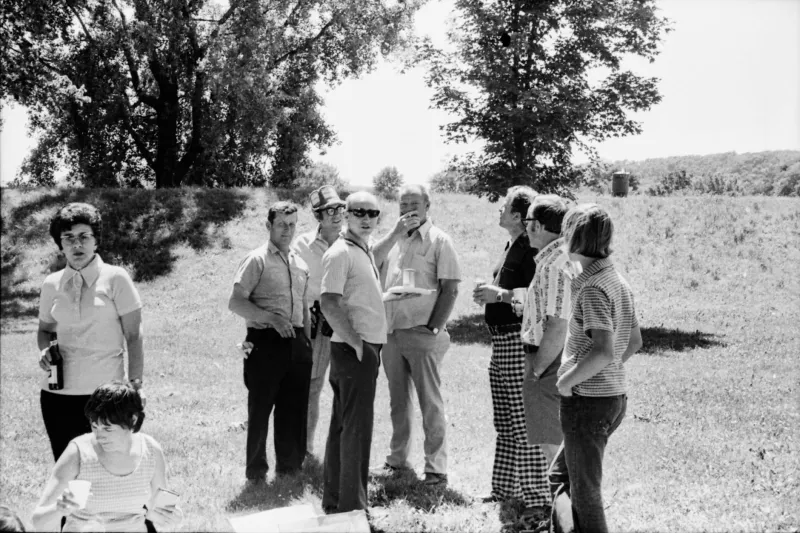
Picture this: It's a Saturday morning in 1975, and Mrs. Patterson from 412 Maple Street is knocking on doors with a clipboard. She's organizing this year's block party, and she needs to know who's bringing what. By noon, she's collected commitments for seventeen casseroles, twelve desserts, and enough folding chairs to seat the entire neighborhood.
 Photo: Maple Street, via images.squarespace-cdn.com
Come Saturday afternoon, Maple Street transforms. Orange traffic cones block both ends. Tables stretch down the middle of the asphalt. Kids who usually aren't allowed to play in the street are suddenly running bases between manholes. Adults who wave politely from their driveways all year are deep in conversation about property taxes and the high school football team.
This wasn't a special occasion. This was just Saturday in America.
The Infrastructure of Friendship
Mid-century American neighborhoods operated on a completely different social architecture. The typical suburban street functioned as an extended living room, with invisible but well-understood boundaries and protocols.
Front porches weren't just architectural features—they were communication hubs. People sat outside in the evenings, creating natural opportunities for conversation. Kids played elaborate games that spanned multiple yards, creating connections between families. The local newspaper was delivered by a neighborhood kid who knew everyone's schedule and preferences.
Most importantly, people stayed put. The average American family in 1950 lived in the same house for over a decade. This stability created the time and incentive to invest in neighborhood relationships.
The Borrowed Cup of Sugar Economy
Neighborhood life operated on an intricate system of informal exchange that economists now recognize as crucial social capital. People borrowed tools, shared babysitting duties, and kept spare keys for each other. The famous "cup of sugar" wasn't just about baking—it was a socially acceptable way to check in on neighbors and maintain relationships.
This system worked because everyone understood the rules. You borrowed the lawnmower on Saturday, but you returned it with a full gas tank. You watched the Johnson kids during their parents' date night, knowing they'd reciprocate when you needed it. These weren't formal arrangements—they were the invisible threads that held communities together.
Contrast this with today's neighborhood dynamics, where many people would rather order supplies online than ask a neighbor for help. We've traded interdependence for independence, often without realizing what we lost in the process.
The Great Retreat Indoors
Several forces conspired to empty America's front porches and sidewalks. Air conditioning made staying inside more comfortable than sitting on the porch. Television provided entertainment that competed with neighborly conversation. Suburban design shifted toward backyards and privacy fences rather than communal front spaces.
But the real game-changer was the changing nature of work and family life. As commutes lengthened and both parents entered the workforce, the time and energy available for neighborhood relationships diminished. The casual encounters that built community—chatting while getting the mail, supervising kids' outdoor play, working in visible front yards—became increasingly rare.
By the 1990s, sociologist Robert Putnam documented this shift in "Bowling Alone," showing how Americans had become dramatically less connected to their immediate communities. We weren't just bowling alone—we were living alone, even when surrounded by neighbors.
 Photo: Robert Putnam, via iei.nd.edu
The Numbers Tell the Story
The statistics on neighborly connection paint a stark picture of social change:
- In 1950, 65% of Americans could name at least ten neighbors. Today, that number has dropped to 23%.
- The average American in 1970 had meaningful conversations with 6.2 neighbors per month. By 2010, that number had fallen to 1.4.
- Block parties requiring street closures dropped from over 15,000 annually in major cities during the 1960s to fewer than 3,000 today.
- The percentage of Americans who have never spoken to their next-door neighbor has risen from 8% in 1975 to 28% today.
These aren't just numbers—they represent a fundamental shift in how Americans experience daily life.
The Digital Paradox
Social media promised to reconnect us, but it often had the opposite effect on neighborhood relationships. Why walk over to ask about the best local plumber when you can post the question in a Facebook group? Why attend the community meeting when you can follow local issues online?
Digital tools solved many practical problems that used to require neighbor-to-neighbor interaction. Apps like Nextdoor attempted to recreate neighborhood connections online, but they often amplified conflicts rather than building relationships. The anonymous or semi-anonymous nature of digital communication lacks the social pressure and empathy that face-to-face relationships naturally create.
What Strong Neighborhoods Actually Provided
The loss of neighborhood connection isn't just nostalgic—it has measurable impacts on health, safety, and quality of life. Research consistently shows that people living in connected neighborhoods experience:
Better Physical Health: Neighborhoods with strong social ties have lower rates of heart disease, depression, and premature death. The simple act of having people who notice when you're absent and check on your welfare provides a crucial safety net.
Increased Safety: Crime rates drop significantly in neighborhoods where residents know each other. Criminals avoid areas where they're likely to be recognized and where residents look out for each other's property.
Economic Benefits: Connected neighborhoods maintain higher property values and attract more local businesses. The informal networks help residents find jobs, share resources, and support local commerce.
Child Development: Kids who grow up in connected neighborhoods develop better social skills, have more adult mentors, and engage in less risky behavior. The "village" that raises children isn't just a metaphor—it's a measurable factor in healthy development.
The Architecture of Isolation
Modern suburban design actively discourages the casual interactions that build neighborhood relationships. Garage-focused front facades mean people can come and go without encountering neighbors. Large lots create physical distance. Privacy fences eliminate the casual over-the-fence conversations that previous generations took for granted.
New developments often lack the sidewalks, front porches, and shared spaces that facilitate natural encounters. The cul-de-sac, designed to create safe, quiet neighborhoods, also eliminated the through-traffic that brought people together.
Signs of Revival
Some American communities are working to rebuild neighborhood connections. New Urbanism design principles prioritize walkability and shared spaces. Community gardens create reasons for neighbors to work together. Tool libraries and little free libraries provide modern versions of the borrowed sugar economy.
The COVID-19 pandemic sparked unexpected neighborhood revival in many areas. Suddenly homebound Americans rediscovered their immediate surroundings. Socially distanced porch conversations, neighborhood walking groups, and mutual aid networks reminded people of the value of local connections.
The Investment of Place
Building neighborhood relationships requires something modern Americans often resist: commitment to place. Strong neighborhoods develop over time, through repeated interactions and shared experiences. They require showing up—to block parties, community meetings, local events—even when it's inconvenient.
This investment feels increasingly countercultural in a society that values mobility and individual choice above community obligation. But research suggests that people who invest in neighborhood relationships, even when they don't plan to stay permanently, experience higher levels of life satisfaction and better mental health.
Beyond the Block Party
The block party was never really about the party—it was about creating a reason for neighbors to see each other as people rather than just the folks who live in that house with the loud dog. It was about building the social infrastructure that makes communities resilient.
We can't simply recreate the neighborhood dynamics of 1975—too much has changed about how Americans live and work. But we can be intentional about creating new ways to connect with the people who share our immediate geography.
Because at the end of the day, your neighbors are the people most likely to notice if you don't come home, to help when your basement floods, and to share the small daily experiences that make a place feel like home rather than just an address.
The street party may be over, but the human need for community remains as strong as ever.